Most Requested Symbols

Today we review how momentum has fared so far in Q3 and what you need to know as we move towards the close of 2026.
NDW Morning Pulse - September 23, 2026
Below are highlights from the NDW Morning Update Video for the morning of 9/23. Access the video on the NDW Morning Update Video page.

As the end of the third quarter approaches, we are offered an opportunity to look underneath the hood of momentum strategies and their overall position as we rapidly approach the end of 2026. After all, gauging the health/intensity of trend following can be quite useful as we build our expectations for Q4, particularly as we construct a gameplan with clients in end of year discussions. Just like any factor, momentum can go through fits and spurts as natural rotation occurs across the investment landscape. However, it is important to remember that momentum is also a self-correcting factor: it will naturally rotate to areas of leadership over time and avoid points of identified weakness. In this way momentum is a particularly unique factor- value will always be value, even if the area struggles for years at a time, same for growth, low volatility, etc. With that said, momentum has put together a particularly productive year in 2026… but you wouldn’t know that if you just looked at performance throughout the last few months. Despite falling nearly 8% since the start of Q3 (6/30-9/21), factor proxy MTUM has still picked up over 26% so far in 2026. This is nearly double that of the broad market, which has advanced nearly 13.5% on a YTD basis. Again, Q3 has been quite unproductive for MTUM, which has quickly fallen off 2026 highs on its default chart.
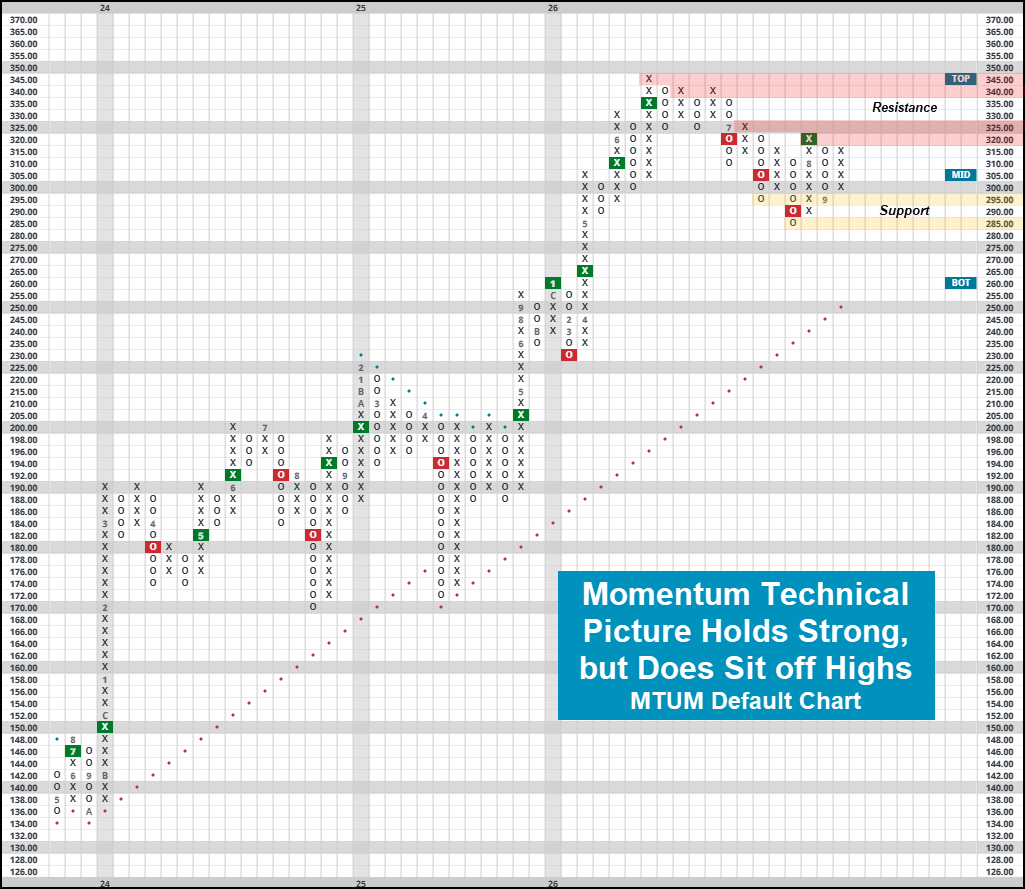
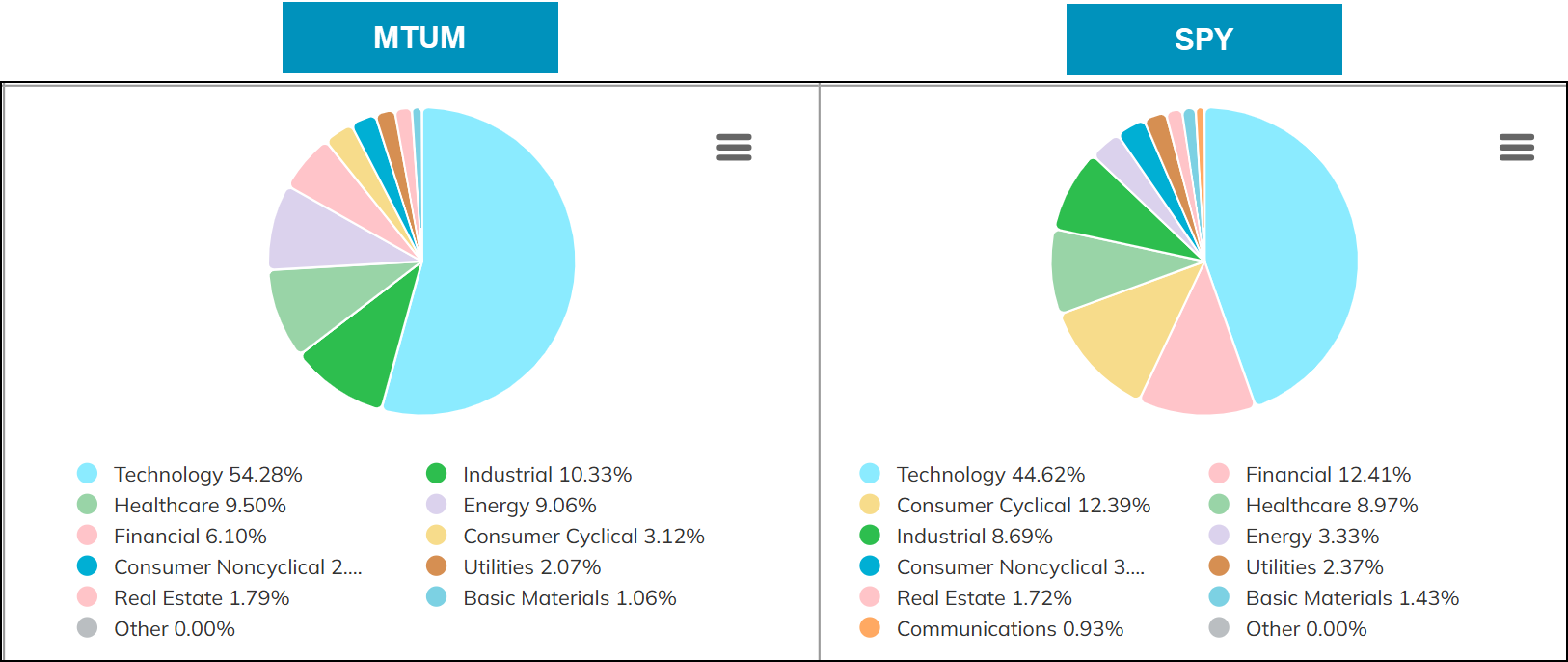
Despite the retreat off all-time highs above, the technical posture for MTUM is still quite strong. Earning a 5.0/6.0 fund score as of 9/21, the fund maintains a strong uptrend and relative favor against broad benchmark SPXEWI. While the period of consolidation between current levels and highs at $345 is certainly notable, the silver lining for trend followers looks to be the somewhat strong support below, ranging from $285-$295. Heading into Q4, we will look for a continued expansion from current leadership to push the factor towards highs to close out the year. Speaking of current leadership, it can be useful to analyze current holdings of the fund to help identify where momentum is picking up leaders and avoiding laggards. Using NDW’s fund comparison tool, we can observe a handful of noticeable differences in sector exposure. Of note includes comparatively large overweights towards technology (54% vs.44%) energy (9% vs. 3%) with small overweights to the likes of healthcare and industrials. On the flip side, observable differences in exposure to consumer discretionary (3% vs. 12%) & financials (6% vs. 12%). Remember, momentum strategies typically rely on consistent winners and losers, taking advantage of the spread between these groups. Heading into Q4, we will look for this spread to expand.
Knowing a spread between high and low performing assets exists is one thing, quantifying it is another. At NDW, we typically chart the spread between winners and losers via Point and Figure chart RSSPREAD. Higher values signal a wide spread between high RS assets and low RS assets, an environment typically productive for momentum strategies. As you would expect due to its poor performance in Q3, this spread has dissipated over the last few months, now sitting well off 2026 highs as rotation has tightened the spread between strong & weak assets. While this certainly doesn’t ensure an unproductive landscape for trend following, knowing RSSPREAD has declined can help confirm the idea that asset leadership is in flux- an important point to keep in the back of your mind heading into Q4. Despite Q3 being largely unproductive, YTD values still point to an expansion of leadership that momentum has been able to take advantage of. The charts below highlight performance of different momentum quintiles over the course of 2026, with our “top” representing high RS assets and “bot” representing low RS assets. Across the globe, we have seen these high strength names outperform the majority of other buckets. As we discussed in yesterday’s feature this has led to a productive environment for trend followers, particularly on the international front.

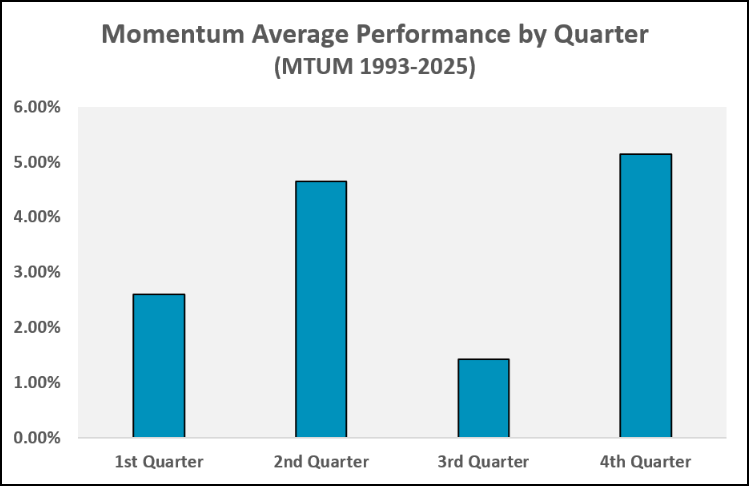
Quickly wrapping up, there are also some seasonal tailwinds in play. Like broader markets, momentum representative MTUM has historically been quite positive in Q4, seeing the fund positive in nearly 75% of Q4’s since 1993. While we can’t be sure exactly why this occurs, we can playfully chalk it up to a generally good mood of money managers around the holiday season or the tendency to stuff client assets into what has worked that year ahead of end of year reviews. While seasonal tendencies are anything but a guarantee, we will certainly take what we can get as we rocket towards the end of the year.
Each week the analysts at NDW review and comment on all major asset classes in the global markets. Shown below is the summary or snapshot of the primary technical indicators we follow for multiple areas. Should there be changes mid-week we will certainly bring these to your attention via the report.
| Universe | BP Col & Level (actual) | BP Rev Level | PT Col & Level (actual) | PT Rev Level | HiLo Col & Level (actual) | HiLo Rev Level | 10 Week Col & Level (actual) | 10 Week Rev Level | 30 Week Col & Level (actual) | 30 Week Rev Level |
|---|---|---|---|---|---|---|---|---|---|---|
| ALL |
|
44% |
|
38% |
|
30% |
|
40% |
|
48% |
| NYSE |
|
48% |
|
54% |
|
24% |
|
36% |
|
50% |
| OTC |
|
42% |
|
32% |
|
30% |
|
42% |
|
46% |
| World |
|
44% |
|
46% |
|
|
|
46% |
|
40% |

Remember, these are technical comments only. Just as you must be aware of fundamental data for the stocks we recommend based on technical criteria in the report, so too must you be aware of important data regarding delivery, market moving government releases, and other factors that may influence commodity pricing. We try to limit our technical comments to the most actively traded contracts in advance of delivery, but some contracts trade actively right up to delivery while others taper off well in advance. Be sure you check your dates before trading these contracts. For questions regarding this section or additional coverage of commodities email james.west@nasdaq.com.
Data represented in the table below is through 9/22:
| Symbol | Name | Price | PnF Trend | RS Signal | RS Col. | 200 Day MA | Weekly Mom |
|---|---|---|---|---|---|---|---|
| CL/ | Crude Oil Continuous | 90.52 | Positive | Sell | X | 80.84 | + 10W |
| DWACOMMOD | NDW Continuous Commodity Index | 1260.59 | Positive | Buy | X | 1159.76 | - 2W |
| GC/ | Gold Continuous | 4342.70 | Positive | Buy | O | 4533.57 | - 2W |
| HG/ | Copper Continuous | 6.77 | Negative | Sell | X | 6.07 | - 3W |
| ZG/ | Corn (Electronic Day Session) Continuous | 536.75 | Positive | Sell | X | 452.35 | + 12W |

Average Level
-8.32
| < - -100 | -100 - -80 | -80 - -60 | -60 - -40 | -40 - -20 | -20 - 0 | 0 - 20 | 20 - 40 | 40 - 60 | 60 - 80 | 80 - 100 | 100 - > |
|---|---|---|---|---|---|---|---|---|---|---|---|
|
Sell signalhyg
|
|||||||||||
|
Sell signalagg
|
Buy signalVOOG
|
||||||||||
|
Sell signalief
|
Buy signalIJH
|
Sell signalEEM
|
|||||||||
|
Buy signalicf
|
Buy signalrsp
|
Buy signaldia
|
Buy signaldx/y
|
Buy signalONEQ
|
|||||||
|
Buy signalijr
|
Buy signaliwm
|
Sell signallqd
|
Buy signalefa
|
Buy signalSPY
|
Buy signalxlg
|
||||||
|
Sell signalshy
|
Sell signaldvy
|
Sell signalfxe
|
Sell signaltlt
|
Buy signalVOOV
|
Buy signalgld
|
Buy signalUSO
|
Buy signalQQQ
|
Buy signalGSG
|
Buy signalgcc
|
||
| < - -100 | -100 - -80 | -80 - -60 | -60 - -40 | -40 - -20 | -20 - 0 | 0 - 20 | 20 - 40 | 40 - 60 | 60 - 80 | 80 - 100 | 100 - > |
| AGG | iShares US Core Bond ETF |
| USO | United States Oil Fund |
| DIA | SPDR Dow Jones Industrial Average ETF |
| DVY | iShares Dow Jones Select Dividend Index ETF |
| DX/Y | NYCE U.S.Dollar Index Spot |
| EFA | iShares MSCI EAFE ETF |
| FXE | Invesco CurrencyShares Euro Trust |
| GLD | SPDR Gold Trust |
| GSG | iShares S&P GSCI Commodity-Indexed Trust |
| HYG | iShares iBoxx $ High Yield Corporate Bond ETF |
| ICF | iShares Cohen & Steers Realty ETF |
| IEF | iShares Barclays 7-10 Yr. Tres. Bond ETF |
| LQD | iShares iBoxx $ Investment Grade Corp. Bond ETF |
| IJH | iShares S&P 400 MidCap Index Fund |
| ONEQ | Fidelity Nasdaq Composite Index Track |
| QQQ | Invesco QQQ Trust |
| RSP | Invesco S&P 500 Equal Weight ETF |
| IWM | iShares Russell 2000 Index ETF |
| SHY | iShares Barclays 1-3 Year Tres. Bond ETF |
| IJR | iShares S&P 600 SmallCap Index Fund |
| SPY | SPDR S&P 500 Index ETF Trust |
| TLT | iShares Barclays 20+ Year Treasury Bond ETF |
| GCC | WisdomTree Continuous Commodity Index Fund |
| VOOG | Vanguard S&P 500 Growth ETF |
| VOOV | Vanguard S&P 500 Value ETF |
| EEM | iShares MSCI Emerging Markets ETF |
| XLG | Invesco S&P 500 Top 50 ETF |

| Symbol | Company | Sector | Current Price | Action Price | Target | Stop | Notes |
|---|---|---|---|---|---|---|---|
| FR | First Industrial Realty Trust | Real Estate | $61.89 | mid-to-hi 60s | 86 | 59 | 4 for 5'er, top 25% of REAL sector matrix, LT pos peer RS, spread sextuple top, R-R>2.0, 2.9% yield |
| AME | Ametek Inc | Electronics | $245.41 | mid 230s - mid 250s | 342 | 204 | 4 for 5'er, LT pos mkt RS, bullish catapult, buy on pullback, R-R>2.0 |
| WELL | Welltower Inc. | Real Estate | $230.39 | low 230s to low 250s | 366 | 194 | 5 for 5'er since Feb. '24, top quintile of Real Est. matrix, Pos. trend since Feb. '24, buy on pullback. |
| CENTA | Central Garden & Pet Company | Household Goods | $34.72 | mid-to-hi 30s | 48 | 31 | 4 for 5'er, favored HOUS sector, LT pos peer RS, spread quad top, buy on pullback |
| CLH | Clean Harbors Inc | Waste Management | $312.85 | 310s - 320s | 356 | 288 | 5 for 5'er, #3 of 22 in WAST sector matrix, LT pos peer & mkt RS |
| AU | AngloGold Ashanti Limited (South Africa) ADR | Precious Metals | $104.60 | 100s - low 110s | 144 | 92 | 4 for 5'er, top 20% of favored PREC sector matrix, LT pos peer RS, one box from mkt RS, R-R~2.0, 4.1% yield |
| ASC | Ardmore Shipping Corporation | Transports/Non Air | $17.77 | 17 - 19 | 24 | 15.50 | 5 for 5'er, top 20% of favored TRAN sector matrix, triple top, good R-R, 7.5% yield |
| ASX | ASE Industrial Holding Co., Ltd. Sponsored ADR | Semiconductors | $45.20 | hi 30s | 52 | 31 | 5 for 5'er, top 10% of SEMI sector matrix, LT pos peer & mkt RS, triple top, R-R~2.0 |
| NET | Cloudflare Inc Class A | Internet | $353.00 | 308 - 336 | 408 | 268 | 5 for 5'er, ranks 2nd in Internet sector matrix, pos. trend on 9/9, ATH on 9/17. |
| MTCH | Match Group, Inc. | Leisure | $41.68 | low-to-mid 40s | 55 | 36 | 4 for 5'er, top 20% of LEIS sector matrix, one box from RS buy, triple top, 1.8% yield |
| FTNT | Fortinet Inc. | Software | $174.26 | hi 160s - hi 170s | 226 | 142 | 5 for 5'er, top third of favored SOFT sector matrix, LT pos mkt RS, spread quad top |
| CSTL | Castle Biosciences, Inc. | Biomedics/Genetics | $34.84 | 32 - 35 | 63.50 | 28 | 4 for 5'er, top 10% of favored BIOM sector matrix, multiple buy signals, pos trend flip, R-R~4.0 |
| Symbol | Company | Sector | Current Price | Action Price | Target | Stop | Notes |
|---|
| Symbol | Company | Sector | Current Price | Action Price | Target | Stop | Notes |
|---|---|---|---|---|---|---|---|
| GHRS | GH Research Plc | Biomedics/Genetics | $27.95 | 28 - 33 | 46.50 | 24 | GHRS has fallen to a sell signal. OK to hold here. Maintain $24 stop. |
| MBX | MBX Biosciences, Inc. | Biomedics/Genetics | $62.01 | hi 50s - low 60s | 78 | 52 | MBX has fallen to a sell signal. OK to hold here. Maintain $52 stop. |
| Comment | |||||||
|---|---|---|---|---|---|---|---|
|
|
|||||||
CSTL Castle Biosciences, Inc. R ($34.48) - Biomedics/Genetics - CSTL is a 4 for 5'er that ranks in the top decile of the favored biomedics/genetics sector matrix. In last week's trading, the stock completed a third consecutive buy signal and returned to a positive trend when it broke a double top at $36. Long exposure may be added in the $32 - $35 range and we will set our initial stop at $28, which would take out two levels of support on CSTL's default chart. We will use the bullish price objective, $63.50, as our target price, giving us a reward-to-risk ratio of around 4.0.
| 26 | |||||||||||||||||||||||||||||
| 44.00 | X | • | 44.00 | ||||||||||||||||||||||||||
| 43.00 | X | O | • | 43.00 | |||||||||||||||||||||||||
| 42.00 | X | X | O | • | 42.00 | ||||||||||||||||||||||||
| 41.00 | X | O | X | O | • | 41.00 | |||||||||||||||||||||||
| 40.00 | X | X | O | X | O | • | Top | 40.00 | |||||||||||||||||||||
| 39.00 | X | O | X | O | X | O | • | 39.00 | |||||||||||||||||||||
| 38.00 | X | O | X | 1 | 2 | • | 38.00 | ||||||||||||||||||||||
| 37.00 | X | C | O | • | 37.00 | ||||||||||||||||||||||||
| 36.00 | X | O | • | X | 36.00 | ||||||||||||||||||||||||
| 35.00 | X | O | X | X | 35.00 | ||||||||||||||||||||||||
| 34.00 | X | O | X | O | X | 34.00 | |||||||||||||||||||||||
| 33.00 | X | O | X | X | O | X | 33.00 | ||||||||||||||||||||||
| 32.00 | X | O | X | X | O | X | 9 | 32.00 | |||||||||||||||||||||
| 31.00 | X | O | X | O | 8 | O | X | 31.00 | |||||||||||||||||||||
| 30.00 | X | O | X | O | X | O | X | Mid | 30.00 | ||||||||||||||||||||
| 29.00 | X | O | X | O | X | O | 29.00 | ||||||||||||||||||||||
| 28.00 | • | X | O | O | X | 28.00 | |||||||||||||||||||||||
| 27.00 | • | X | 3 | X | 27.00 | ||||||||||||||||||||||||
| 26.00 | • | B | O | X | 26.00 | ||||||||||||||||||||||||
| 25.00 | • | A | O | X | 7 | 25.00 | |||||||||||||||||||||||
| 24.00 | • | X | O | X | O | X | 24.00 | ||||||||||||||||||||||
| 23.00 | • | X | 4 | X | O | 6 | 23.00 | ||||||||||||||||||||||
| 22.00 | X | • | X | O | 5 | X | 22.00 | ||||||||||||||||||||||
| 21.00 | X | O | • | X | X | O | X | Bot | 21.00 | ||||||||||||||||||||
| 20.00 | O | X | X | O | X | • | X | O | X | • | O | X | • | 20.00 | |||||||||||||||
| 19.50 | O | X | O | X | O | X | O | X | O | X | • | O | X | • | 19.50 | ||||||||||||||
| 19.00 | 4 | X | O | X | 5 | X | O | X | O | • | O | X | • | 19.00 | |||||||||||||||
| 18.50 | O | X | O | O | X | 7 | X | • | O | X | • | 18.50 | |||||||||||||||||
| 18.00 | O | X | O | X | O | X | • | O | • | 18.00 | |||||||||||||||||||
| 17.50 | O | O | X | X | O | X | • | • | 17.50 | ||||||||||||||||||||
| 17.00 | O | X | O | 6 | O | X | • | 17.00 | |||||||||||||||||||||
| 16.50 | O | X | O | X | O | X | • | 16.50 | |||||||||||||||||||||
| 16.00 | O | O | X | O | X | • | 16.00 | ||||||||||||||||||||||
| 15.50 | O | O | X | • | 15.50 | ||||||||||||||||||||||||
| 15.00 | 8 | • | 15.00 | ||||||||||||||||||||||||||
| 26 |
| ABBV AbbVie Inc. ($265.20) - Drugs - ABBV inched higher to complete a triple top break at $268, marking its fourth consecutive buy signal. The 3 for 5'er ranks in the top third of the drugs sector matrix. Although there has been much improvement in recent months, ABBV is still rated a hold. Continue waiting for further improvement. Initial strong support can be seen between $244-$248. |
| DE Deere & Company ($709.48) - Machinery and Tools - Nice break for DE today. We are a touch overbought around current levels, but you could look for exposure on pullbacks to new support around $672. The industrials space is weakening... a point to keep in mind, but DE remains a high attribute 5/5'er as we move into Q4. |
| EXPE Expedia Group Inc. ($261.71) - Leisure - EXPE broke a double bottom at $260 for a third sell signal since late August. The break follows the stock shifting into a negative trend earlier in September and will place the market RS chart in a column of Os, dropping the stock down to a 3 for 5'er. From here, support lies at $252, while additional lies at $220 and $208. |
| GILD Gilead Sciences, Inc. ($150.19) - Biomedics/Genetics - GILD inched higher to complete a double top break at $154, marking its third consecutive buy signal. The 3 for 5'er moved up from a 2 on 9/22, after reversing back into Xs against the market. Additionally, the stock ranks in the top half of the biomedics/genetics sector matrix. Continue to wait for further improvement before considering, as the stock is still rated a hold. Initial support is at $144, with additional strong support between $128-$130. |
| SPHR Sphere Entertainment Co. ($137.30) - Leisure - SPHR broke a triple bottom at $140 to return to a sell signal and violate the bullish support line as shares fell to $138. The trend change will drop the stock down to a 3 for 5'er and will bring the stock to the cusp of falling into the bottom half of the Leisure sector matrix. Support lies at current levels, while additional can be found at $134, which dates to June of this year. |
| URBN Urban Outfitters, Inc. ($74.40) - Retailing - URBN broke a double bottom at $74 for a second sell signal since rallying to $85 in August. The move violates the bullish support line, which will flip the trend to negative and drop the stock down to a 3 for 5'er in technical attribute rating. From here, support lies at $72, while additional can be found in the mid to upper $60s. |
| VLO Valero Energy Corp ($376.44) - Oil Service - VLO gave an initial sell signal Wednesday when it broke a double bottom at $372. The outlook for the stock remains positive despite Wednesday's move as VLO is a 5 for 5'er that ranks eighth out of 77 names in the oil service sector matrix. From here, the next level of support sits at $336. |
| WOR Worthington Enterprises Inc. ($60.40) - Steel/Iron - WOR returned to a buy signal and a positive trend Wednesday when it broke a double top at $61. The outlook for the stock remains negative, however, as even with the positive trend change WOR is an unfavorable 2 for 5'er. WOR now sits against resistance at $67, while support can be found at $57. |
The option suggestions featured here are pulled from the NDW Options Ideas tool. These are just a sample of the ideas that can be found there. The Options Idea tool contains numerous additional income and speculative plays. It also offers relative strength-based screens targeting the highest (and lowest) relative strength stocks and ETFs that have recently moved counter to their longer-term trend. To access or subscribe to the Options Ideas tool, click here.
Call
BP PLC (BP) Dec $18 $44 Call
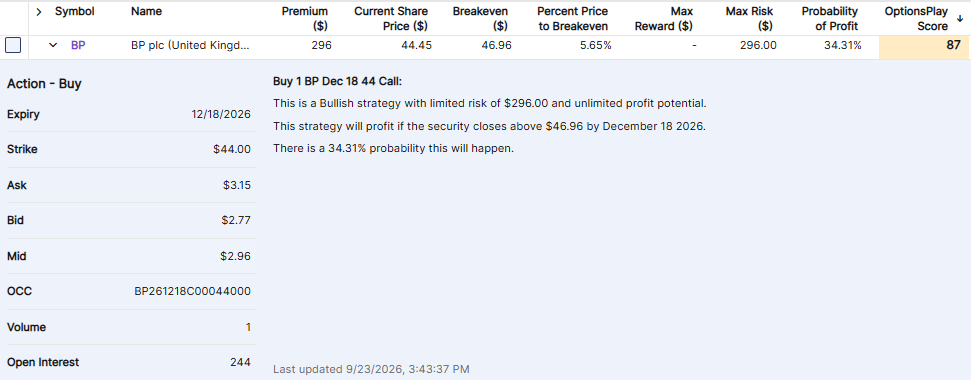
| Additional Data: | |
| Bid/Ask Spread | 13.72% |
| Delta | 58.17 |
| Gamma | 6.14 |
| Implied Volatility | 32.05% |
| Expiry Date | 86 |
| Earnings Date | 10/30/2026 |
Put
State Street SPDR S&P Retail ETF (XRP) Dec 18 $83 Put

| Additional Data: | |
| Bid/Ask Spread | 52.73% |
| Delta | -47.96 |
| Gamma | 4.58 |
| Implied Volatility | 24.42% |
| Expiry Date | 86 |
Income
Devon Energy Corp (DVN) Oct 23 $45 Short Put

| Additional Data: | |
| Ann. Static Return | 20.05% |
| Bid/Ask Spread | 39.34% |
| Delta | 23.47 |
| Gamma | -6.09 |
| Implied Volatility | 37.23% |
| Expiry Date | 30 |
| Earnings Date | 11/4/2026 |
Daily Equity & Market Analysis
Loading, Please Wait...

